

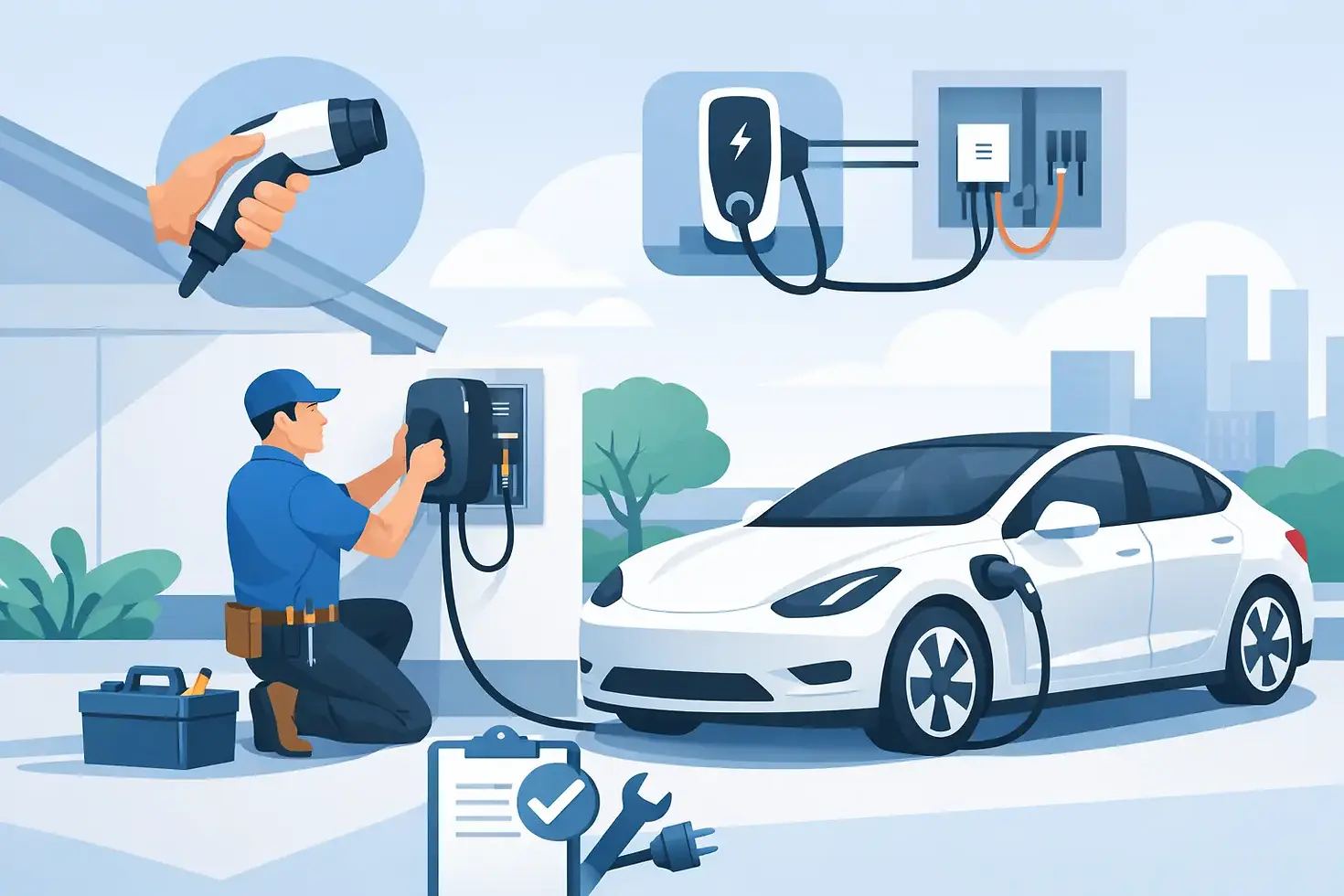
How to Get Electric Car Charger Installed
The first time you rely on a public charger during a cold Montreal evening, home charging starts to feel less like a nice upgrade and more like a practical necessity. If you are wondering how to get electric car charger installed, the process is usually straightforward - but only when the electrical work is planned properly from the start.
A home EV charger is not just a wall-mounted device. It is a dedicated electrical installation that has to match your vehicle, your panel capacity, your parking setup, and local code requirements. Done correctly, it gives you predictable charging, better day-to-day convenience, and fewer surprises down the road.
How to get electric car charger installed at home
The first step is figuring out what kind of charging setup actually fits your property. Most homeowners are looking at a Level 2 charger because it delivers much faster charging than a standard wall outlet. A regular 120V outlet can work for some drivers with short daily commutes, but for many households it is too slow to be practical, especially in winter or in homes with more than one vehicle.
A Level 2 charger typically requires a dedicated 240V circuit. That means the electrical panel, breaker size, wire run, and installation location all need to be assessed before anyone starts drilling into walls or mounting equipment. This is where a licensed master electrician adds real value. The goal is not only to make the charger work, but to make sure the installation is safe, code-compliant, and sized for long-term use.
Start with the electrical panel
The most important question is whether your panel has enough capacity for an EV charger. Some homes have available space and sufficient electrical service, which makes the job fairly simple. Others need a load calculation to confirm whether a new 240V circuit can be added without overloading the system.
If your home already has electric heating, a hot tub, a pool, or other major loads, the answer may not be obvious. In some cases, the charger can still be installed by using load management equipment or by adjusting the charging setup to suit the home's capacity. In other cases, a panel upgrade is the cleaner long-term solution.
This is one of the biggest points where it depends. Two homes on the same street can have very different installation requirements based on service size, panel age, and how the property is already wired.
Why panel capacity matters
An EV charger draws power for extended periods. That sustained load is different from many household devices that cycle on and off. If the circuit is undersized or the panel is already near its limit, you risk nuisance tripping at best and unsafe conditions at worst.
A proper assessment should confirm available amperage, breaker compatibility, wiring path, and whether any upgrades are needed before the charger is connected.
Choose the right charger, not just the popular one
Many EV owners start by looking at charger brands and smart features. Those things matter, but they should come after the electrical basics. The right charger depends on your vehicle, your driving habits, and how quickly you actually need to recharge.
Some drivers do well with a lower-amperage Level 2 charger because the car is parked overnight for long periods. Others want higher charging output to recover range more quickly between trips. If you have two EVs now or expect to add one later, it may make sense to plan for future demand instead of installing the bare minimum.
There is also the question of hardwired versus plug-in chargers. A hardwired unit is often the more durable and streamlined option. A plug-in charger can offer flexibility, but it still needs the correct receptacle, circuit, and protection. The best choice depends on the charger model, the installation environment, and how permanent you want the setup to be.
Pick the installation location carefully
Where the charger goes affects both cost and convenience. A charger mounted close to the panel is often easier and less expensive to install because the wire run is shorter and the labour is simpler. But the closest wall is not always the most practical one.
You want the cable to reach the charge port comfortably without stretching across a walkway, garage door opening, or parking area in a way that becomes annoying every day. Outdoor installations also need weather-appropriate equipment and proper mounting methods.
For detached garages, older homes, or exterior parking spaces, the installation may involve more complex routing. That does not make the project difficult, but it does mean the quotation should account for the real conditions on site instead of assuming a basic setup.
Permits, code, and why DIY is the wrong move
If you are asking how to get electric car charger installed properly, the answer includes permits and code compliance. EV charger installation is not a handyman project. It is electrical work that needs to be done to code, with the right protection, the right conductor sizing, and the right equipment.
In Quebec, electrical work has to meet regulatory requirements, and that matters for both safety and liability. A non-compliant installation can create problems with inspections, insurance, future home sales, or equipment performance. It can also void manufacturer expectations if the charger was not installed according to specifications.
A certified electrician will know how to evaluate the service, size the circuit, install the charger correctly, and handle the work in a way that aligns with applicable standards. That expertise saves time, but more importantly, it avoids expensive corrections later.
What the installation process usually looks like
Once the site has been assessed, the process is typically quite efficient. The electrician reviews your panel, confirms the charger model or recommends one, determines the circuit requirements, and plans the wire route. If a permit or approval is required, that gets addressed before the work begins.
On installation day, the work usually includes adding a dedicated breaker, running the wiring, mounting the charger, making the final electrical connections, and testing the system. If the installation is simple and the panel is nearby, it can often be completed in a single visit. If the job requires a service upgrade or more extensive wiring, the timeline will be longer.
Good electricians also take the time to explain how the charger operates, what charging speed to expect, and any limitations tied to your specific setup. That practical handoff matters. A charger is only convenient if the user actually knows how to get the best from it.
Cost depends on more than the charger itself
One of the most common misconceptions is that the charger price tells you the total project cost. In reality, the hardware is only part of it. Labour, wire length, breaker type, panel condition, wall construction, exterior work, trenching if needed, and possible service upgrades all affect the final number.
A straightforward installation in an attached garage with available panel capacity will usually cost much less than an installation on a detached structure with limited service and a long cable run. Neither scenario is unusual. They are just different jobs.
This is why a proper quote matters. The goal should be accuracy, not a low placeholder number that changes once work starts.
For condos, rentals, and commercial properties
Homeowners are not the only ones looking into EV charging. Property managers and commercial operators are dealing with the same question, but with more layers. In a condo or multi-unit setting, charger installation may involve building rules, shared electrical infrastructure, and coordination with boards or owners. In a commercial setting, the issue is often usage patterns, access control, parking layout, and operational continuity.
The electrical work still comes first. A commercial or shared-use charger has to be installed with the same focus on capacity, safety, and compliance, but planning becomes more strategic. It is not just about one vehicle anymore. It is about how the charging setup fits the property over time.
How to avoid common mistakes
Most installation problems start before the work begins. People buy a charger before checking panel capacity, assume any garage outlet can be adapted, or choose a mounting location based only on aesthetics. Others try to save money by using non-specialized labour, which often leads to rework.
The better approach is simple. Have the property assessed first, choose equipment that fits the actual electrical conditions, and make sure the installation is done by a qualified professional. That reduces delays and gives you a charging setup you can rely on every day.
For homeowners and property managers in Montreal's West Island and surrounding areas, that local experience matters because housing stock varies, winter conditions are real, and electrical upgrades need to be done with care. Pine Electrique approaches EV charger installation the way it should be handled - with precision, code compliance, and a clear plan from the outset.
If you are ready to stop planning your schedule around public charging, the next step is not guessing which charger to buy. It is getting a proper electrical assessment so the installation fits your property as well as your vehicle.


